
Extraits / Excerpts









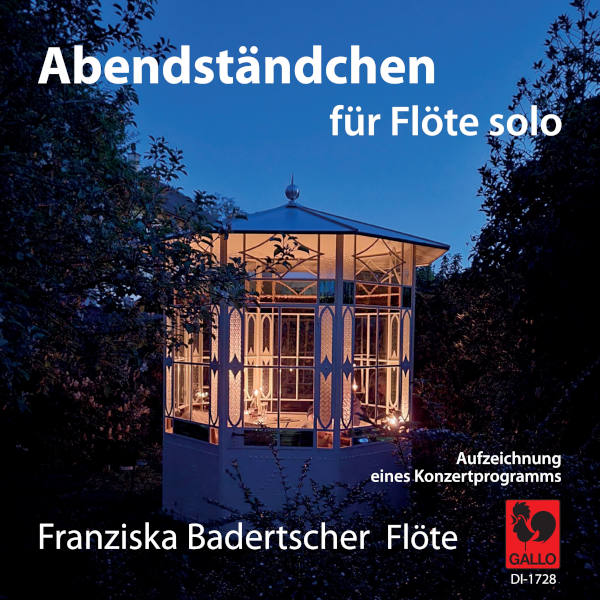
Abendständchen für Flöte solo - Franziska Badertscher
Joseph LAUBER: Feux follets, Op. 47, No. 3 – Șerban NICHIFOR: Invocatio – Liana ALEXANDRA: Sonata No. 2 – Roger BOURDIN: La Chanson de Pan – Claude DEBUSSY: Syrinx, L. 129 – Kazuo FUKUSHIMA: Mei – Katherine HOOVER: Kokopeli – Marin MARAIS: Les Folies d’Espagne – Ruth SCHONTHAL: Theme and Variations – Francis POULENC: Un joueur de flûte berce les ruines, FP 114
Franziska Badertscher, Flute.
https://franziskabadertscher.ch/
The Magical Flute!
The flute is a magical instrument. It is obvious that a sound is produced when an object is struck or rubbed—it is an everyday experience familiar to everyone. But that is not the case with the flute—all that is involved is air. Since air can be perceived but not seen, it is associated from the outset with the ethereal and the magical. This magical, supposedly non-physical—metaphysical—element surrounds and permeates us throughout our lives, from the beginning—when “the breath of life” is breathed into us—to the end, when we feel “the breath of death.”
The shepherd god Pan also experienced this. After his beloved, a naiad named Syrinx, transformed herself into a reed to escape her pursuer, the wind sang so beautifully through the reeds that Pan cut one and made it into his flute. He could now “breathe life” into his beloved—a story that feminists would find rather questionable, since it begins with an act of violence—cutting the reed and removing it from its social context—and ends with a classic male fantasy: that a woman only truly comes to life when a man “plays” her…
In many of the pieces we will have the pleasure of hearing tonight, the theme of the flute as a “magical” instrument takes center stage. The journey through the enchanted garden begins with Joseph Lauber’s “Irrlichtern,” which leads us from the late Romantic period into more modern times. With Nichifor, we arrive at a quiet place of contemplation and reflection; with his wife Alexandra, we encounter an unbridled palette of diverse emotions—similar to what we will hear later with Hoover, whose “Kokopeli”—the name of a prehistoric Hopi variant of Pan—sounds like a panopticon of the possibilities offered by the flute.
Bourdin and Fukushima, too, explore the magic of the mystical, though in Fukushima’s case, as expected, the richly layered history of Japanese shakuhachi art serves as inspiration. Like a contemplative retrospective, Marais’s “Folies d’Espagne” remind us that imaginative wanderings through the musical labyrinth were already possible in the Baroque era.
Schonthal created a category of her own with her “Variations.” The composer titled another cycle of variations “Variations in Search of a Theme.” Aside from being a beautiful title, this also serves as a listening guide: let us begin our search with Lauber, then pause for a moment with Nichifor, before allowing ourselves to be swept away by all the adventures that surround, seduce, stir, unsettle, and delight us in the enchanted garden of the flute—and perhaps, in the process, we will find our own theme…
It goes without saying—and needs no further praise or admiration—that a concert for a solo instrument challenges not only composers and performers but also the audience. After all, one thing is clear: not only is the flute a magical instrument, but those who play it must also possess magical powers.
David Wohnlich
Franziska Badertscher is dedicated to both the classical flute repertoire and contemporary and experimental music. She is active in free improvisation and enjoys breaking new ground with her often surprising ideas.
In her studio concerts, Franziska Badertscher establishes new connections between diverse forms of artistic expression and weaves them together. Her work is characterized by a spirit of exploration and a willingness to take risks. Chamber music lies at the heart of her work. She performs in various established ensembles as well as in many different configurations.
The artist is particularly committed to Swiss musical creation and contemporary music. She has given world premieres of chamber music works by composers David Wohnlich, Robert Suter, René Gerber, Meinrad Schütter, and John Frith. Many of these compositions were dedicated to Franziska Badertscher.
Franziska Badertscher’s name also appears on chanson and cabaret programs, and during the Basel Fasnacht, she can be glimpsed—perhaps even spotted—under a mask as she parades through the alleys to marches composed especially for her.
Flute, improvisation, cabaret, Fasnacht, chansons—labels that confine and limit, but which Franziska Badertscher redefines and places in ever-surprising contexts.
Education:
Concert diploma under Conrad Klemm, Winterthur University of Music
Master’s degree in improvisation, Basel University of Music
Teaching diploma under Kiyoshi Kasai, Basel SMPV
Masterclasses with Maxence Larrieu, Trevor Wye, and Robert Dick
Study visit with Robert Dick in New York
Workshop with composer Pauline Oliveros
Postgraduate course in free improvisation, Basel University of Music
Vocal training with Barbara Martig-Tüller, Bern
- Categories
- Composers
- Interprets
- Booklet